

JOB
Let’s go back to basics. To how you and I understand the job we’re worried AI will take away – the thing that provides our means of earning a living.
Forgive the simplifications and obvious statements, but let’s start by making sure we’re on the same page.
What are the essential necessities a human needs to live?
Perhaps you’ve never asked yourself this question, or you simply accepted the understanding of it as natural, requiring no clarification.
But let’s imagine this through the scenario of a deserted island where you’ve ended up stranded, alone with the elements and your thoughts.
So, you need:
- Food that keeps you alive and healthy
- Drinking water
- Shelter from the environment (such as a dwelling or building, as well as clothing)
- Some form of medicine in case of illness (hoping, of course, to avoid situations like tooth extraction or surgical intervention)
Some might argue there’s a fifth item missing from this list.
Humans are social beings – we need at least one other person to stay mentally healthy. Complete isolation can drive us crazy. So maybe human connection belongs on the list of fundamental necessities too.
With this list of fundamental human necessities in hand, let’s return from the deserted island to inhabited environments.
How do you fulfill each of these life necessities?
How do you provide yourself with food, water, shelter, clothing, and medical care?
Option One:
Learn to obtain (create/make) all of this yourself. That is, know how to grow or gather food, obtain drinking water, construct shelter, create clothing, and make medicines for treatment.
Option Two:
Obtain all of this from external sources. Someone or something can provide all this to you. Free of charge or in exchange for something.
Option Three:
A mixture of the first and second options. You do some things yourself, you obtain some things from others.
Let me mention this upfront:
when you do work for yourself with your own hands (grow food, make water drinkable, build shelter, create clothing and footwear, make medicines), AI is unlikely to take that away from you.
Moreover, it might even simplify things or teach you with its knowledge. After all, you’re doing this by your own efforts. For yourself.
(However, you could be forcibly prohibited from doing things yourself and compelled to obtain everything only from external sources.)
What interests you and me more is the second option for fulfilling necessities.
When we choose (or are compelled) to obtain things from external sources:
- Either for free.
But obviously, since you’re reading these lines, that’s not our case.
- Or in exchange for something. In exchange for something we can create or do.
And this is our case. When we have a job that allows us to cover all our life necessities (at minimum).
And this job – this means of earning a living – is what AI can, generally speaking, take away from us.
HUMAN
Humans are, let’s be honest, lazy by nature.
You can search for millions of excuses or explanations if you’d like, but eventually, everyone agrees this is simply true.
Throughout our history, we’ve almost always wanted someone else to do things for us. The reasons hardly matter… because it’s raining and cold outside and you don’t feel like hunting, so let someone else go instead. And so on and so forth.
This pattern runs throughout our entire history.
We’ve almost always used power (force) and/or money to make someone or something work for us. Or let’s be more honest – work in our place?
Of course, there’s always an exception – creative people (creators): composers, poets, inventors of various kinds. For them, this doesn’t come from necessity but from natural gift. They simply create. To them, it isn’t work at all. Unlike most of us, who would choose not to work over work.
Returning to this reluctance to work and its reflection throughout human history, we can observe that this reluctance has evolved roughly along the following progression:
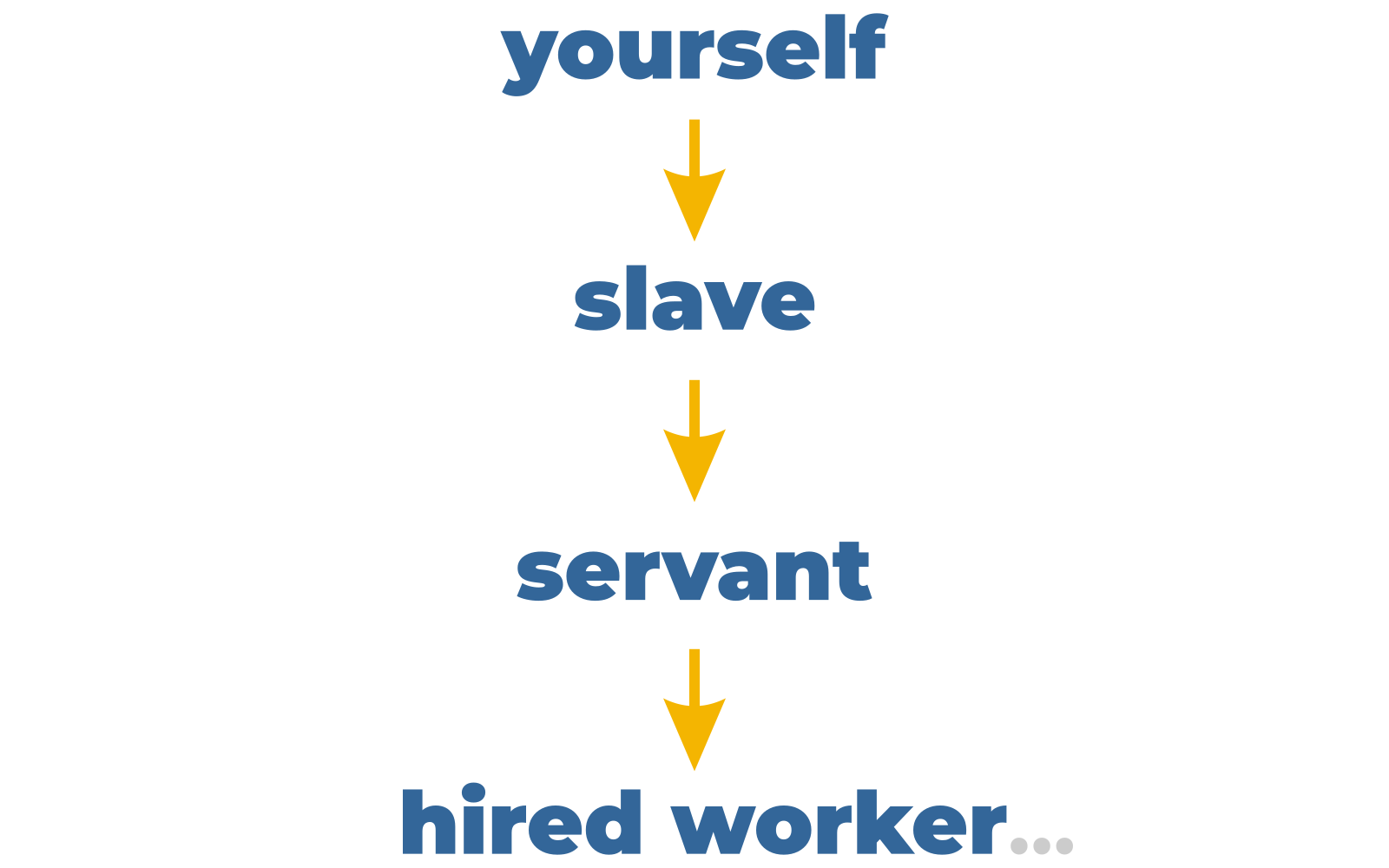
And then, starting around the second half of the 19th century, something new arrives (brought by technological progress, or more precisely, the Industrial Revolution): the idea that work can be performed not only by humans or other living creatures like animals, but by machinery.
Looking back, we can draw a striking conclusion: we humans have always wanted (and still do) to remove the weak link from the production process. And this makes perfect sense: why wouldn’t we?
Whether that weak link was some animal limited by its physical abilities or by the excessive care it required, or whether it was humans themselves, limited by practically the same constraints.
Humanity, throughout history, has been trying to replace itself in production processes with something – recognizing itself as one of the weak links in the chain.
FUTURISTICA
And this technological progress amazed people so much – the fact that mechanisms (machines) could perform work previously done by humans and animals – that the visionaries of that time began to shift people’s attention away from fairy tale genies and introduced everyone to robots.
Human imagination painted a picture of robots as our helpers and even workers.
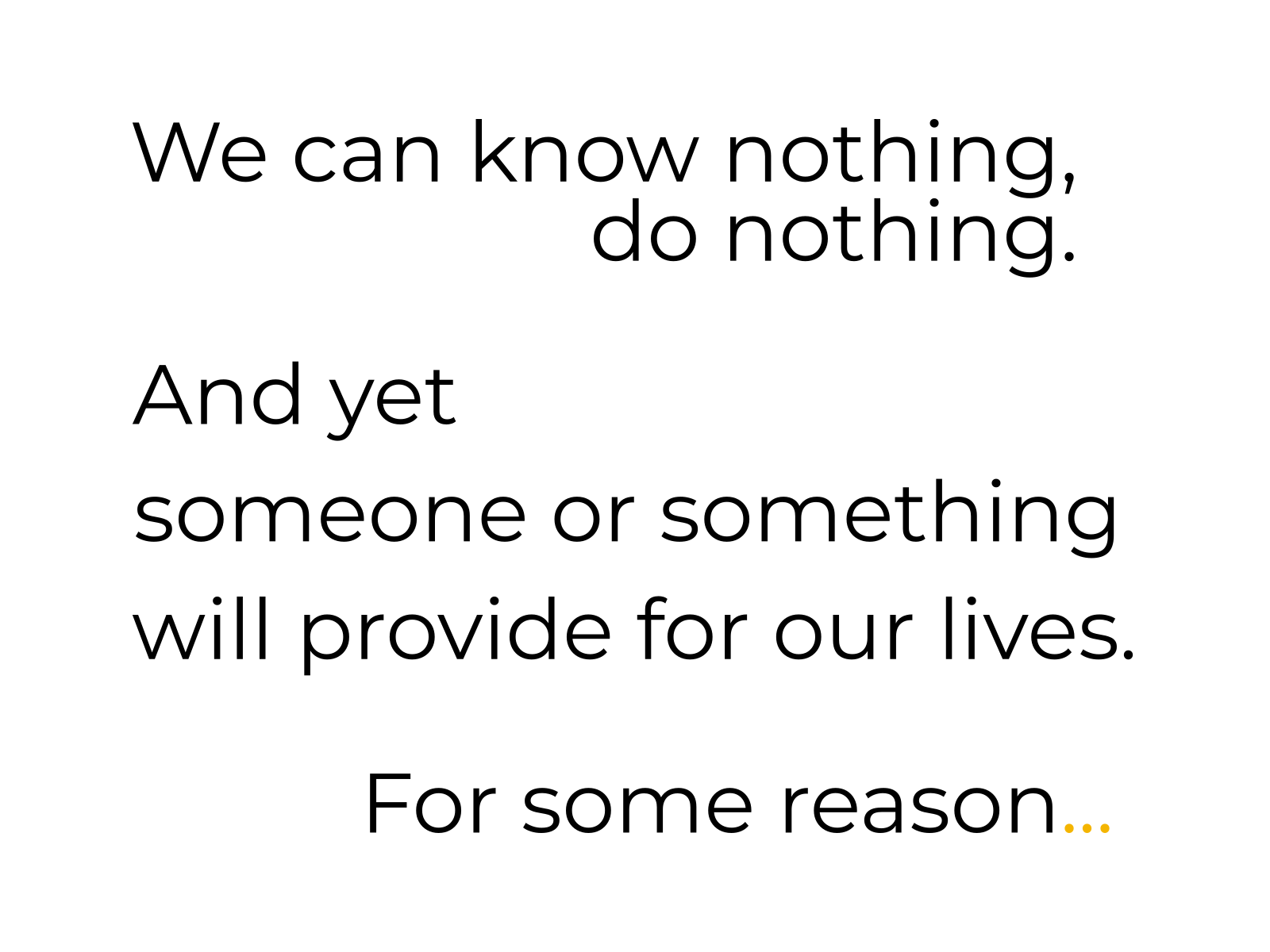
They would do everything for us and in our place. And we? We could just do nothing.
However, back then the technology was far from perfect: many obstacles stood in the way of their mechanical (physical) creation, programming their actions, creating an interface for their communication with us humans, and embedding some knowledge (skills) into them.
Of course, we shouldn’t forget that a robot isn’t just some humanoid hunk of metal.
They come in infinite forms.
Even a washing machine is a robot.
If at its creation it simply agitated laundry with detergent, now it weighs the load, adds detergent in portions, heats water for different types of fabric, performs various washing manipulations, and even dries the clothes.
Dirty laundry goes in, clean and dried laundry comes out.
Nowadays we’re practically at that historical moment in our evolution when Artificial Intelligence and highly advanced robotics make it possible to get what we all dreamed of:
having someone or something do the work that would provide us with everything for life.
Come on, admit it – we wanted this. Desired it. At least a little.


OR
you could tell us what you think:



